
Back in 2016, hashtags were powerful. But do they still matter in 2026?
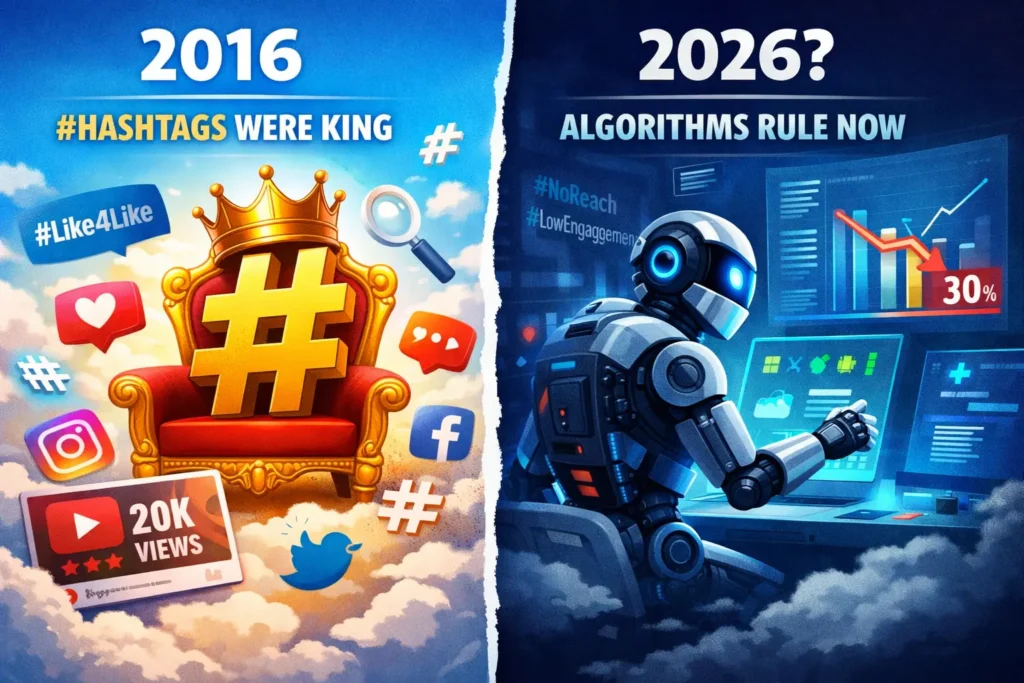
If you were active on social media around 2016, you probably remember one key rule:
“Use more hashtags to get more reach.”
Back then, creators spent a lot of time searching for the right hashtags. Some even added 20 to 30 tags to each post because it genuinely helped their content get discovered. I experienced this firsthand.
In 2016, I had a small YouTube channel and actively used hashtags in my video descriptions. At that time, hashtags played an important role in helping videos show up in searches and suggested results. I remember getting nearly 20,000 views on one of my videos largely due to effective hashtag use. It felt like a simple growth hack: find the right tags, add them, and your content would reach new audiences.
But today, in 2026, things feel completely different. Even when creators use many hashtags, their content often struggles to reach people. This raises an important question: Have hashtags lost their power, or are we just using them the wrong way?
Why Hashtags Used to Work So Well
In the early days of social media, hashtags were very important. Platforms relied on them to understand content. They worked like labels. When you added a hashtag, you told the platform exactly what your content was about.
For example, if someone searched for a specific hashtag, they could easily find related posts. This made hashtags one of the simplest ways for creators to get discovered. At that time, algorithms were much simpler. They depended heavily on hashtags to categorize posts and decide where they should appear. That’s why hashtags were once seen as essential for growth.
What Changed Over Time
The biggest change came with the rise of advanced artificial intelligence in social media algorithms. Today, platforms no longer need hashtags to understand content. They can analyze posts automatically using AI.
Modern algorithms can now recognize:
· What happens inside a video
· The text written in captions
· Spoken words in reels and shorts
· How users engage with the content
Because of this, hashtags are no longer the main signal used to determine reach. Instead, algorithms focus much more on user behavior. For example, if viewers fully watch a video, comment, or share it, the platform treats it as valuable and promotes it further. I’ve noticed this shift firsthand. Unlike in 2016, using hashtags alone doesn’t guarantee reach anymore. Even with the right tags, content may not find its intended audience if engagement signals are weak.
Are Hashtags Completely Useless Now?
Not entirely. Hashtags still have some value, but their role has changed significantly.
· They can still help with: Reaching niche communities
· Helping users find content through search
· Organizing posts around specific themes or events
However, for feeds driven by algorithms like Instagram Reels or YouTube Shorts, hashtags have little impact on how widely content is shared. What matters more now is how people interact with the content itself.
Common Hashtag Mistakes People Still Make Many creators continue to follow outdated hashtag strategies. Some add a large number of random hashtags hoping for better reach. Others copy the same set of hashtags for every post without checking their relevance. Another common mistake is relying solely on highly popular hashtags with extreme competition. These practices don’t work well today because algorithms now prioritize engagement signals rather than metadata.
What Matters More Than Hashtags Today
In 2026, social media platforms focus mainly on content performance. Algorithms care more about:
· How quickly a post grabs attention
· How long viewers stay engaged
· Whether people comment, share, or save the content
· Consistency in posting
If content keeps people interested, it will naturally reach a wider audience even without heavy hashtag use. That’s why many viral posts today succeed with very few hashtags or none.
How to Use Hashtags Smartly Today
Instead of abandoning hashtags completely, creators should use them strategically. Using a small number of relevant hashtags is more effective than adding many random ones. Niche hashtags can also help connect content with a targeted audience. Most importantly, hashtags should now be seen as a supporting tool rather than the main driver of reach.
Final Thoughts
Hashtags haven’t completely disappeared, but their importance has clearly declined. Back in 2016, they played a major role in helping content reach audiences. Today, they are just one small factor among many. My experience reflects this shift from gaining thousands of views through hashtags alone to seeing how little impact they have in today’s algorithm-driven environment. In 2026, the real key to visibility is not how many hashtags you use, but how your audience responds to your content. Strong engagement will always matter more than strong hashtags.